Amazon has rolled out its new DD+7 reserve policy – and let’s not sugarcoat it. This isn’t just a technical update. It’s a fundamental shift in how sellers get paid.
What is DD+7?
Under the new system, Amazon releases your money 7 days after delivery.
Not after shipment. Not after the sale. After delivery — plus a full week.
So the new reality looks like this:
- You sell the product
- You ship it
- The customer receives it
- You wait again
- Only then you get paid
Every delay in shipping now directly delays your cash.
The reasoning behind it
Amazon positions this policy as a way to improve customer protection and marketplace stability. By holding funds longer, they gain time to resolve issues before releasing money.
That logic makes sense operationally. But it also shifts financial pressure downstream – onto sellers.
What sellers are saying
The reaction across seller forums has been far from positive. Many describe the system as confusing, slow, and difficult to manage in real business conditions.
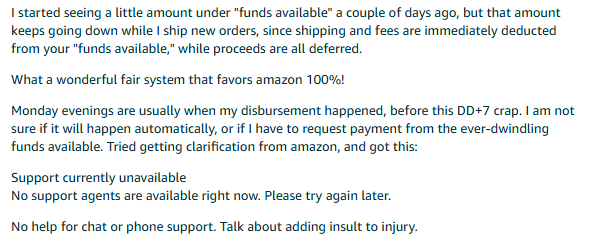
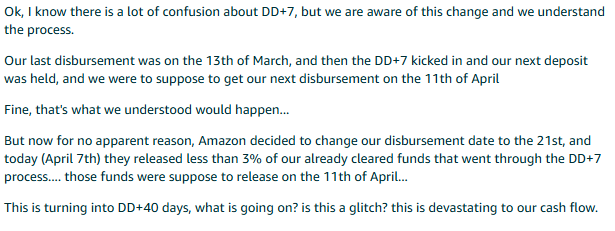



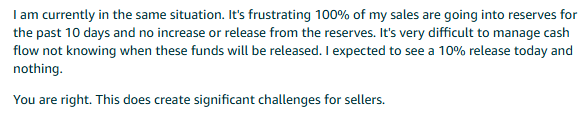
Source: sellercentral.amazon.com/seller-forums
A common theme runs through all of them: sellers feel like they are constantly waiting for money that used to be accessible much faster.
Why it matters more than it seems
This policy doesn’t reduce your revenue, but it compresses your cash flow – and that distinction is critical. Ecommerce businesses don’t operate on profit alone; they depend on fast, predictable access to cash.
When payouts slow down, everything else slows with them:
- restocking inventory becomes harder
- advertising becomes more constrained
- supplier relationships become more sensitive
Even stable businesses can feel pressure when liquidity tightens.
The bigger picture
DD+7 is ultimately about control. Amazon gains more time and reduces its financial exposure, while sellers absorb the delay and adjust their operations around it.
Nothing is taken away on paper, but in practice, access is everything.
Final thought
You are still making sales, and your revenue hasn’t disappeared. But under DD+7, your ability to use that money when you need it has changed – and in ecommerce, timing is often more important than the total itself.